Can You Actually Stand on Your Swimming Pool Cover in 2025?
The answer depends on your cover type, and understanding the difference could save a life.
Every Minnesota pool owner eventually asks this question, usually after watching snow accumulate on their covered pool or wondering about pet safety. The answer isn't simple because "pool cover" describes multiple different products with vastly different weight-bearing capabilities.
Some pool covers are designed to support multiple adults. Others will collapse under a toddler's weight, creating a drowning hazard worse than leaving the pool uncovered.
With Plan Pools' ASTM certified automatic safety covers included in every installation, you get genuine weight capacity and protection that many pool contractors don't provide.
The Critical Difference: Safety Covers vs. Winter Covers
Before answering "can you stand on your pool cover," you must first identify which type of cover you have.
ASTM Certified Safety Covers: YES, You Can Stand On Them
Automatic safety covers and mesh safety covers that meet ASTM F1346 standards are specifically designed to support human weight.
These covers must withstand at least 485 pounds concentrated in a 2-foot by 2-foot area anywhere on the cover. This means an average adult (or multiple children) can walk on these covers without falling through into the water.
The purpose of this design requirement is drowning prevention. If a child wanders onto a properly installed ASTM certified safety cover, the cover will support their weight and prevent them from entering the water.
Plan Pools installs only ASTM F1346 certified automatic safety covers because we believe genuine safety protection is non-negotiable.
Winter Covers and Solar Covers: NO, Never Stand On Them
Traditional winter covers (solid tarps held by water bags or stakes) and solar bubble covers provide ZERO weight support.
If you step on a winter cover or solar cover, you will immediately fall through into the water below. Worse, the cover material may wrap around you, creating an entrapment hazard that can lead to drowning even in shallow water.
These covers are designed for debris protection (winter covers) or heat retention (solar covers), not safety. They should never be treated as if they can support weight.
Many budget pool contractors install winter covers as standard equipment, creating a false sense of security. At Plan Pools, we include automatic safety covers because we've seen too many close calls with inadequate cover systems.
Understanding Your Pool Cover Type
Minnesota swimming pool owners need to identify their cover type to understand its capabilities and limitations.
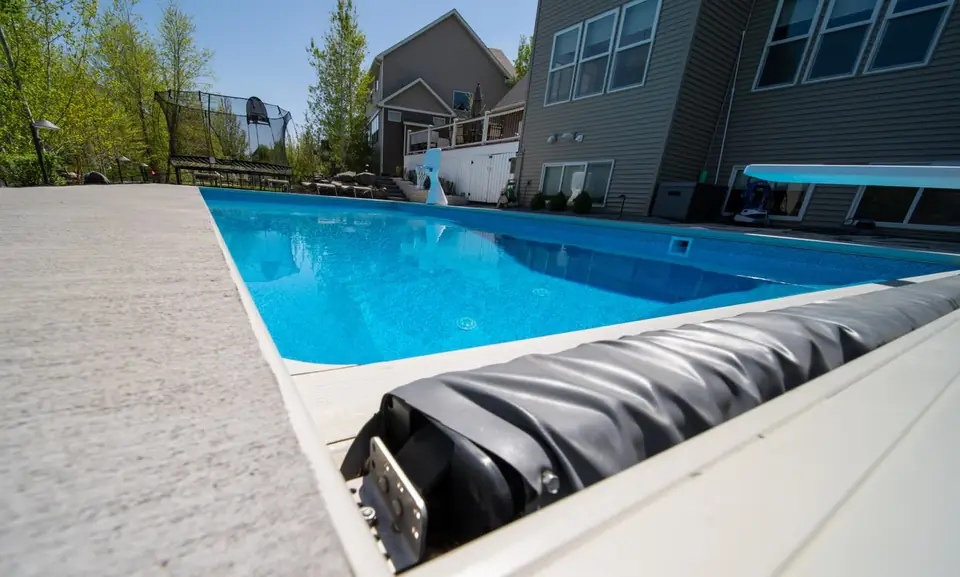
Automatic Safety Covers
Physical characteristics:
- Rigid fabric material (vinyl or mesh)
- Tracks mounted on both sides of pool
- Motor housing at one end
- Operated by key switch
- Cover retracts into housing when open
Weight capacity: 485+ pounds (ASTM F1346 certified models)Can you stand on it?: Yes, but avoid when possible to preserve lifespan
Safety protection: Prevents drowning if child or pet ventures onto covered pool
Plan Pools includes automatic safety covers with every installation. They provide superior protection compared to manual cover systems.
Manual Mesh Safety Covers
Physical characteristics:
- Porous mesh fabric that allows water to drain through
- Anchors around entire pool perimeter (typically every 3-4 feet)
- Springs attach cover to anchors
- Must be manually pulled over pool and secured
- Removed and stored when pool is open
Weight capacity: 485+ pounds (when ASTM F1346 certified and properly installed)Can you stand on it?: Technically yes, but anchors can loosen over time compromising safety
Safety protection: Provides drowning prevention when properly maintained
Solid Winter Covers
Physical characteristics:
- Non-porous tarp material (usually blue or green)
- Held in place by water bags around perimeter OR stakes driven into deck
- Lies loosely on water surface
- Water, snow, and debris accumulate on top
- Must be manually removed in spring
Weight capacity: NONE - not designed to support any weight
Can you stand on it?: Absolutely not - immediate fall-through hazard
Safety protection: Zero - creates entrapment hazard
Solar Covers (Bubble Covers)
Physical characteristics:
- Thin plastic material with air bubbles on one side
- Floats directly on water surface
- No anchoring system
- Typically rolled up on reel when not in use
- Covers water surface to retain heat and reduce evaporation
Weight capacity: NONE - not designed to support any weight
Can you stand on it?: Absolutely not - immediate fall-through hazard
Safety protection: Zero - provides false security
Why Some Pool Covers Support Weight and Others Don't
Understanding the engineering behind different cover types helps you make informed decisions about your backyard swimming pool.
Safety Cover Design Principles
ASTM certified safety covers are engineered specifically for load bearing:
Strong fabric materials: Woven vinyl or mesh with high tensile strength designed to distribute weight across entire cover surface
Reinforced webbing: Heavy-duty webbing sewn into cover creates load-bearing structure that prevents fabric from tearing under concentrated weight
Secure anchoring: Multiple anchor points around entire perimeter (typically every 2-3 feet) distribute load into deck structure
Maintained tension: Proper tension keeps cover taut, preventing sagging pockets where someone could fall through
Quality stitching: Double or triple stitched seams with UV-resistant thread that won't fail under stress
Plan Pools' automatic safety covers incorporate all these design elements, meeting or exceeding ASTM F1346 requirements.
Why Winter Covers Can't Support Weight
Winter covers are fundamentally different in design and purpose:
Thin material: Lightweight tarp material designed for economy and easy handling, not strength
No structural support: No webbing or reinforcement to distribute loads
Loose placement: Sits on water surface with no tension, immediate collapse under weight
Perimeter-only attachment: Held only at edges with no internal support structure
Wrong application: Designed for debris protection, not safety
The Dangerous Middle Ground
Some pool contractors sell "safety covers" that look like safety covers but don't meet ASTM F1346 standards. These covers may have some webbing and anchors but lack the engineering and testing to reliably support weight.
Critical warning: Only covers specifically labeled as ASTM F1346 certified should be trusted to support weight. Marketing claims like "safety cover" mean nothing without this certification.
When You Can (and Can't) Stand on Safety Covers
Even with ASTM certified safety covers designed to support weight, you should understand proper usage.
When Standing On Safety Covers Is Acceptable
Emergency access: If you must reach something in the pool area and the cover is in place, ASTM covers support your weight safely
Pet rescue: If your pet ventures onto the cover, you can safely walk out to retrieve them without cover failure
Accidental weight: The primary purpose - if a child accidentally wanders onto the covered pool, the cover prevents drowning
Snow removal: You can carefully stand on specific areas to sweep or blow snow from cover surface (though working from edges is safer)
When You Should Avoid Standing On Safety Covers
Routine maintenance: Use leaf blower or brush from pool edge rather than walking on cover
Showing off: Demonstrating weight capacity to friends accelerates wear without benefit
With sharp objects underfoot: Branches, ice, or debris can puncture cover when compressed by your weight
On wet covers: Extremely slippery, creating fall hazard even though cover supports weight
Repeatedly in same spots: Concentrating wear in specific areas compromises long-term integrity
Best practice: While safety covers can support your weight, avoid walking on them except when necessary. This preserves cover lifespan and maintains safety performance.
What Happens When Someone Stands on the Wrong Cover Type
Understanding the risks helps emphasize the importance of proper cover selection.
Winter Cover Scenario
When someone steps on a winter cover:
- Immediate collapse: Cover provides zero resistance, person falls through into water
- Material wrapping: Tarp material wraps around person as they sink, creating entrapment
- Disorientation: Underwater beneath cover, person may not know which direction leads to air
- Panic and struggling: Entangled in cover material, person fights to find pool edge
- Drowning risk: Especially critical for children who lack swimming ability or strength to escape
This scenario has resulted in numerous drowning deaths, particularly involving young children who ventured onto what parents thought was "safe."
Solar Cover Scenario
Solar covers create similar immediate fall-through, but with thinner material that more readily wraps around the victim. The thin plastic can create a suffocation hazard even for someone who reaches the pool edge.
Why "Proper" Safety Covers Prevent Tragedy
ASTM certified safety covers prevent this entire scenario:
- Weight support: Cover holds person's weight, preventing entry into water
- No collapse: Properly tensioned cover doesn't sag or create pockets
- Secure anchoring: Person can crawl or walk to pool edge on cover surface
- Time for rescue: Adults have time to reach and help child before any danger
- Prevention rather than reaction: Drowning attempt is completely prevented rather than requiring rescue
This prevention capability is why Plan Pools includes ASTM certified automatic safety covers as standard equipment rather than cheaper alternatives.
Minnesota Winter Considerations
Minnesota pool owners face unique challenges with snow and ice accumulation on covers.
Snow Load Weight
Heavy snow can add thousands of pounds to your pool cover. A significant snowfall covering a 16x32 pool with 10 inches of wet snow adds approximately 4,000-6,000 pounds of weight.
ASTM certified safety covers are engineered to handle these snow loads when properly maintained. The distributed load across the entire cover surface remains within design parameters even with heavy accumulation.
Winter covers accumulate water and snow on the loose tarp surface. While the cover itself can't support weight, the water underneath somewhat supports the snow/water mixture on top. However, this creates a dangerous illusion - walking on a winter cover with snow on top is still extremely hazardous because your concentrated weight will break through.
Ice Formation Concerns
Thick ice sheets can form on pool covers during extended cold periods. Some pool owners wonder if they can walk on ice-covered pool covers.
Critical warning: Ice on pool covers is unreliable and dangerous:
- Ice thickness varies across cover surface
- Cover may have failed underneath ice, creating hidden collapse risk
- Ice may be bonded to cover, pulling cover material when you step through
- Fall through ice-covered pool cover is especially dangerous due to cold water and limited access points
Never walk on ice-covered pool covers regardless of cover type. The risk far exceeds any benefit.
Snow Removal Best Practices
When heavy snow accumulates on your automatic safety cover:
Light snow (under 6 inches): Leave in place, will melt and drain naturally
Moderate snow (6-12 inches): Use soft push broom to sweep from pool edge, working from outside edge toward center
Heavy snow (12+ inches): Carefully remove using leaf blower or soft broom, avoiding any tools that could puncture cover fabric
Standing water/ice: Never attempt to break ice, carefully pump water from edges to create air space underneath that allows ice to sink and melt
Plan Pools' automatic safety covers include robust drainage systems that handle Minnesota precipitation better than standard covers.
Real-World Safety Cover Testing
ASTM F1346 certification requires rigorous testing to verify weight capacity claims.
The 485-Pound Test
Covers undergo laboratory testing where 485 pounds is placed on a 2-foot by 2-foot section anywhere on the cover. The cover must:
- Support the weight without allowing penetration to water surface
- Maintain structural integrity without tearing or separating at seams
- Distribute load through webbing and anchoring system without anchor failure
- Return to normal position when weight is removed
This test is repeated at multiple locations on the cover, including areas far from anchor points where load-bearing is most challenging.
Real-World Performance
ASTM certified covers typically perform well beyond minimum requirements:
- Actual weight capacity often exceeds 600-700 pounds
- Can support multiple people simultaneously in different areas
- Withstand repeated loading cycles without performance degradation
- Maintain capacity through years of UV exposure and weather cycling
Plan Pools' premium automatic safety covers consistently exceed ASTM minimums, providing superior protection for your family.
What Testing Doesn't Cover
Important to understand testing limitations:
- Tests assume proper installation with correct anchor spacing and tension
- Tests evaluate new covers in laboratory conditions
- Real-world factors (UV degradation, age, weather stress) reduce capacity over time
- Damaged, worn, or improperly maintained covers may not meet stated capacity
This is why regular inspection and maintenance are critical for maintaining safety performance.
How to Verify Your Pool Cover's Weight Capacity
If you're uncertain about your swimming pool cover's capabilities, follow these steps:
1. Identify Cover Type
Look for ASTM F1346 label: Certified covers have permanent label sewn into fabric stating ASTM F1346 compliance and installation date
Check cover operation: Automatic or manual operation, mesh or solid material, anchoring system type
Review installation documents: Original paperwork from pool contractor should specify cover type and certification
2. Inspect Cover Condition
Visual examination: Look for tears, worn areas, separated stitching, faded fabric indicating UV damage
Anchor check: Verify all anchors are secure and properly tensioned (safety covers only)
Operational test: For automatic covers, ensure smooth operation and proper tension when deployed
3. Determine Age
Check installation date: Most covers have label showing installation date
Consider lifespan: Automatic safety covers typically last 7-10 years with proper maintenance, mesh covers 10-15 years
Factor degradation: Even certified covers lose capacity as they age beyond manufacturer recommendations
4. Contact Manufacturer or Pool Contractor
If uncertain: Contact the pool contractor who installed your pool or the cover manufacturer directly
Request specifications: Ask for documentation of ASTM certification and weight capacity
Consider upgrade: If you have non-safety cover or cover beyond service life, strongly consider upgrading to ASTM certified automatic safety cover
Plan Pools provides complete documentation with every installation, including cover specifications, certification, and maintenance requirements.
Construction Method Affects Cover Safety
Your pool's construction method impacts cover effectiveness and long-term performance.
Steel Wall Pool Cover Problems
Structural movement: Steel wall pools settle and shift over time, especially in Minnesota's freeze-thaw cycles. This causes cover tracks to misalign, reducing safety performance.
Weak anchor points: Steel pool decks are often thinner and less robust, providing inferior anchor mounting. Anchors can pull loose over time.
Coping deterioration: Steel pools with vinyl liners often have plastic or aluminum coping that degrades, compromising cover attachment points.
Heat conduction: Steel walls conduct heat away from water, making covers work harder to retain warmth and creating thermal stress on cover materials.
Plan Pools ICF Advantages
Dimensional stability: Plan Pools' ICF concrete construction provides walls that never shift or settle. Cover tracks remain perfectly aligned forever.
Superior anchoring: Thick concrete decks provide robust, permanent anchor mounting that won't pull loose.
Durable coping: Properly installed concrete coping provides secure, long-lasting cover attachment surface.
Better insulation: ICF walls retain heat, reducing thermal stress on cover materials and extending cover lifespan.
Lifetime warranty: Our structural warranty means cover mounting points remain secure indefinitely.
When building a swimming pool, choose a contractor who understands how construction affects every component, including cover system safety and longevity.
Teaching Children About Pool Cover Safety
Even with automatic safety covers, education is critical.
Key Safety Messages for Children
Never play on pool covers: Even safety covers should not be treated as play surfaces. They're slippery and intended for emergency protection, not recreation.
Stay away from covered pools: Pool area should be off-limits when covered, regardless of cover type.
Understand cover purpose: Older children should know covers are safety devices designed to prevent drowning.
Know emergency procedures: If someone falls onto cover, how to call for adult help immediately.
Pet awareness: Pets don't understand pool covers. Supervise pets near covered pools and teach children to keep pets away.
Multiple Layers of Protection
No single safety measure is foolproof. Implement comprehensive protection:
Barrier fencing: Four-sided fencing with self-closing, self-latching gates meeting Minnesota standards
Door alarms: Alarms on all doors accessing pool area
Adult supervision: Direct, dedicated supervision whenever children are near pool
Swimming lessons: Age-appropriate swimming instruction for all family members
Safety cover: ASTM certified safety cover as final barrier when pool is not in use
Emergency preparation: CPR training, rescue equipment, emergency phone access
Plan Pools can recommend local resources for fencing, alarms, and swimming lessons to complement the safety cover included with your pool.
When to Replace Your Pool Cover
Pool covers don't last forever. Replace your cover when safety performance is compromised.
Signs You Need Cover Replacement
Visible damage: Tears, punctures, or frayed areas in fabric
Separated stitching: Seams pulling apart along webbing or edges
Failed anchors: Anchors pulling out or no longer holding tension
Material degradation: Fabric feels brittle or cracks when flexed
UV damage: Excessive fading or chalky surface texture****
Age exceeded: Cover beyond manufacturer's recommended lifespan
Operational problems: Automatic covers that bind, skip, or won't maintain tension
Do not compromise family safety by extending cover life beyond safe limits. The cost of replacement is insignificant compared to the value of your family's protection.
Cover Replacement Options
Plan Pools offers complete cover replacement services:
Premium automatic safety covers: Same quality included in new installations
Professional installation: Factory-trained technicians ensure proper setup
Warranty coverage: New warranty on replacement cover system
Disposal of old cover: Proper disposal of worn-out cover materials
Updated anchoring: Opportunity to upgrade anchoring system if needed
We also service and maintain covers installed by other pool contractors, though performance may be limited by original installation quality.
Why Plan Pools Includes Premium Safety Covers
Many pool contractors offer automatic safety covers as expensive upgrades or don't offer them at all. Plan Pools includes ASTM certified automatic safety covers as standard equipment in every installation.
Our Safety Philosophy
We've built hundreds of swimming pools across the Twin Cities metro in Lakeville, Prior Lake, Shakopee, Eagan, Maple Grove, and throughout Minnesota. We've seen close calls, heard the statistics, and understand the risks.
We believe family safety isn't optional. Every pool should include genuine safety protection, not economy covers that provide false security.
The Total Value Package
Plan Pools' automatic safety covers provide multiple benefits beyond weight capacity:
- Safety protection: ASTM certified 485+ pound capacity
- Energy efficiency: Reduces heating costs by 50-70% combined with our ICF insulation
- Chemical conservation: Cuts chemical use by 35-50%
- Debris protection: Keeps leaves and dirt out of pool
- Convenience: Push-button operation
- Aesthetic appeal: Retracts completely out of sight
Compare this to pool contractors who install cheap winter covers, then charge thousands more for automatic cover upgrades. Plan Pools includes premium equipment because we build pools designed to outlast our competitors.
Making the Right Cover Decision
Whether building a new swimming pool or upgrading an existing cover system, choose based on your priorities.
For Maximum Safety
ASTM F1346 certified automatic safety cover is the only choice. Plan Pools includes these as standard because we prioritize family protection.
For Convenience
Automatic covers win decisively. Push-button operation versus manual wrestling with tarps determines whether you actually use your cover consistently.
For Energy Efficiency
Automatic solid covers provide best heat retention, especially combined with Plan Pools' 60% heating cost savings from ICF construction.
For Total Value
Automatic safety covers deliver safety, efficiency, convenience, and protection in one system. The value proposition is unmatched.
Ready to Build a Pool with Real Safety Protection?
Don't settle for pool contractors who cut corners on safety or charge heavily for automatic cover upgrades.
Plan Pools includes ASTM F1346 certified automatic safety covers with genuine 485+ pound weight capacity as standard equipment in every custom inground swimming pool we build.
Start your safe pool project today:
- Text photos of your yard to 952-994-6032
- Schedule a no-pressure consultation
- Learn why Minnesota families trust Plan Pools for safety and quality
Your family deserves genuine protection - built into every pool we create, never an expensive upgrade.